
SOQL For-Loop in Salesforce: How to Update Thousands of Records Without Hitting Governor Limits
Learn how SOQL for-loops in Salesforce help update thousands of records efficiently while reducing heap usage and avoiding common governor limit issues.

Learn how SOQL for-loops in Salesforce help update thousands of records efficiently while reducing heap usage and avoiding common governor limit issues.
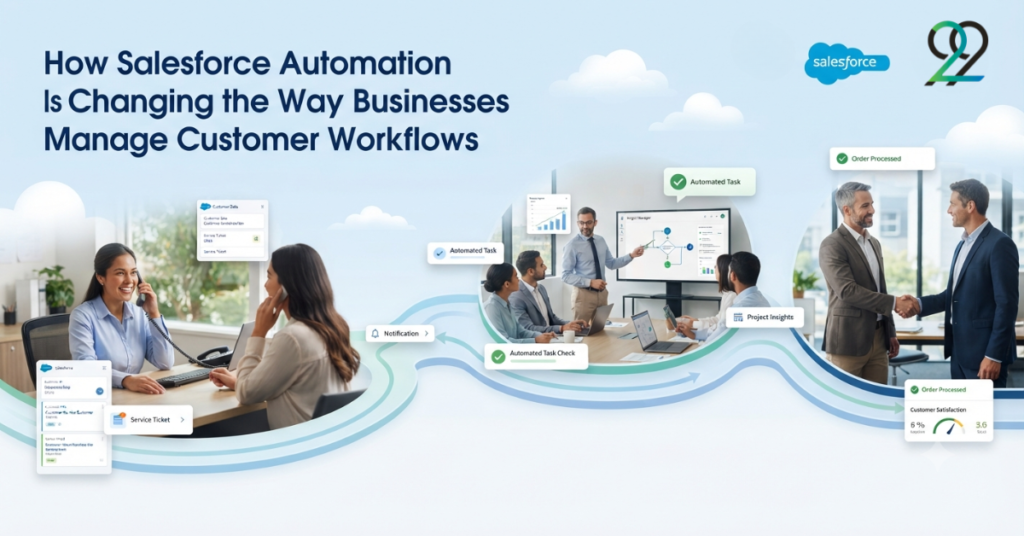
Salesforce automation is changing how businesses manage customer workflows by streamlining repetitive tasks, improving team efficiency, and creating smoother customer experiences.
How Salesforce Automation Is Changing the Way Businesses Manage Customer Workflows Read More »

If you’ve been wondering whether Salesforce is genuinely worth the investment for your business or you’re helping a client decide you’re in the right place. Salesforce is not just a CRM. It’s a connected cloud platform that manages sales pipelines, automates customer journeys, handles complex pricing, and now even deploys AI agents that work independently. Over 150,000 companies worldwide rely on it, including roughly 90% of Fortune 500 firms. But here’s the more important question: does it work for your industry? The honest answer is that Salesforce works remarkably well for some industries and is simply transformative for others. Below, we’ve broken down the ten industries where Salesforce consistently delivers the strongest impact and precisely why. 1. Financial Services Banks, insurance firms, and wealth management companies deal with one of the most demanding combinations in business: highly regulated environments, enormous client data volumes, and zero tolerance for errors in communication. Salesforce’s Financial Services Cloud brings all client data into a single, compliant view from policy details to investment portfolios. It automates routine communications, flags regulatory gaps, and helps relationship managers track every client touchpoint. Financial services firms are, in fact, 7.6 times more likely to use Salesforce Marketing Cloud than the average company. That tells you everything about the trust the industry places in this platform. Relevant 9to9Clouds service: Salesforce CRM Implementation 2. Healthcare & Life Sciences Healthcare organisations carry a unique burden: they must manage patient relationships with both precision and genuine compassion often across fragmented systems. Salesforce Health Cloud consolidates patient records, care plans, and communication histories into one HIPAA-compliant platform. Appointment reminders are automated, reducing no-shows by up to 20%. Care coordinators get a real-time view of patient journeys, making handoffs between departments far smoother. For organisations running complex payer-provider networks, OmniStudio (formerly Vlocity) offers guided workflows that cut through the operational complexity significantly. This is one area where technology genuinely improves patient outcomes, not just operational efficiency. Relevant 9to9Clouds service: OmniStudio / Vlocity Development 3. Retail & E-Commerce Retail is no longer just about selling a product. It’s about building a relationship that keeps customers returning and in a market where switching costs are near zero, that relationship has to be consistently excellent. Salesforce’s Marketing Cloud enables retailers to run personalised, omnichannel campaigns across email, SMS, and social. Salesforce Loyalty Cloud takes it further, letting brands build structured loyalty programmes with points, tiers, and automated rewards. Einstein AI analyses browsing behaviour and surfaces the right product recommendations at the right moment, lifting click-through rates meaningfully. Whether you’re a boutique brand or a large marketplace, this level of personalisation is no longer a luxury, it’s the baseline. Relevant 9to9Clouds service: Salesforce Implementation & Customisation 4. Manufacturing Manufacturing has long dealt with an awkward reality: the products are complex, the sales cycles are long, and quoting errors are expensive. A misconfigured product bundle or an incorrect discount can cost thousands before anyone notices. Salesforce CPQ (Configure, Price, Quote) solves this directly. It allows sales teams to build accurate, approved quotes in a fraction of the time with built-in pricing rules, discount approval workflows, and product bundle logic. Manufacturers using Pardot for marketing automation are also 4.6 times more likely to succeed with long-cycle B2B lead nurturing. The combination of CPQ and intelligent marketing makes a measurable difference to both win rates and margins. Relevant 9to9Clouds service: Salesforce CPQ Implementation 5. Professional Services Consulting firms, law practices, accountancies, and agencies all share the same core challenge: their business runs on relationships, and those relationships need constant, careful attention. Professional services account for the largest share of Salesforce users globally 29.2% of its entire customer base. That’s not a coincidence. Sales Cloud helps firms manage their pipeline with genuine visibility, while Service Cloud supports client success and renewal conversations. Custom dashboards give leadership a clear view of project health, resource utilisation, and revenue forecasts. Retaining a client is always more cost-effective than winning a new one, and Salesforce makes that retention effort far more systematic. Relevant 9to9Clouds service: Managed Support & CRM Optimisation 6. Technology & SaaS For technology companies, speed is everything. Customer expectations change rapidly, churn can happen quietly, and the cost of a poor onboarding experience compounds quickly as you scale. Agentforce Salesforce’s AI agent platform is particularly well-suited here. It deploys autonomous agents that handle tier-one support queries, route complex issues intelligently, and trigger follow-up workflows without any human intervention. Meanwhile, Einstein lead scoring helps sales teams prioritise the accounts most likely to convert. For SaaS businesses tracking MRR and ARR, Salesforce’s reporting gives leadership the kind of real-time financial clarity that spreadsheets simply cannot. Relevant 9to9Clouds service: Agentforce Development 7. Telecommunications Few industries carry the operational complexity of telecoms. Massive product catalogues, high-volume customer interactions, and razor-thin margins on retention all make customer experience both critical and difficult to deliver consistently. OmniStudio, formerly known as Vlocity, and one of Salesforce’s six original industry cloud verticals, was built specifically for this world. OmniScripts guide service agents through complex customer interactions step by step. FlexCards surface real-time account data in a clean, actionable format. Integration Procedures connect Salesforce seamlessly to BSS and OSS systems. The result is a contact centre that operates with genuine intelligence rather than reactive fire-fighting. This is an area where 9to9Clouds has deep, hands-on experience. Relevant 9to9Clouds service: OmniStudio / Vlocity Development 8. Nonprofits & Education Nonprofits often operate with limited budgets and lean teams yet their stakeholder relationships are no less complex than those of a large enterprise. Donors, volunteers, grant bodies, and beneficiaries all need different, thoughtful communication. Salesforce’s Nonprofit Success Pack (NPSP) manages donor journeys, gift tracking, and campaign attribution from a single platform. Universities and EdTech organisations use the Education Data Architecture (EDA) to manage student engagement from enrolment through to alumni relations. Salesforce also offers significant discounts to registered nonprofits, making adoption far more accessible than most organisations realise. Relevant 9to9Clouds service: Salesforce Training & Enablement 9. Real Estate & Construction The real estate sector has been
10 Industries That Benefit Most from Salesforce Read More »
Introduction In the Salesforce ecosystem, moving metadata from one org to another is a common requirement during development, testing, or migration. One of the easiest ways to achieve this is by using Unmanaged Packages. An unmanaged package allows developers and administrators to distribute components such as Apex classes, flows, custom objects, Lightning components, and other metadata between Salesforce organizations. Unlike managed packages, the components inside an unmanaged package remain editable in the destination org. This makes unmanaged packages particularly useful for development sharing, backups, proof-of-concept deployments, and one-time migrations. In this guide, we will walk through the step-by-step process of deploying an unmanaged package from a source org to a target org. Prerequisites Before creating and deploying an unmanaged package, ensure you have the following access and permissions. 1. Access to Source Org You must have login credentials and administrative access to the Salesforce org where the package will be created. 2. Access to Target Org You also need access to the destination org where the package will be installed. 3. Required Permissions Ensure your Salesforce user has the following permissions: Without these permissions, you may not be able to create or install packages. Step 1: Create an Unmanaged Package in the Source Org The first step is to create the package that will contain all the components you want to migrate. Steps to create a package Once saved, Salesforce will create a container where you can add metadata components. Step 2: Add Components to the Package After creating the package, you must include the components that need to be migrated. Steps to add components Common components include: It is important to ensure all dependencies are included, otherwise installation in the target org may fail. Step 3: Upload the Package Once all required components are added, the package must be uploaded to generate a version. Steps to upload Salesforce will process the package and create a versioned upload. Depending on the number of components, the upload may take a few minutes to complete. Step 4: Get the Installation Link After the upload process finishes, Salesforce generates an installation URL. This URL allows the package to be installed in any Salesforce org that has access to the link. Steps You will use this link to install the package in the target org. Step 5: Install the Package in the Target Org Now that you have the installation link, the next step is installing the package in the destination org. Installation process Installation options usually include: Salesforce will begin installing the package and its components into the target org. Step 6: Post-Installation Steps After the installation completes, some additional steps may be required to ensure everything works properly. Verify Components Check if all components have been installed correctly: Assign Permissions Some components require specific permissions or permission sets. Make sure users who need access are assigned the appropriate permissions. Activate Flows Flows are often installed in inactive mode. You must manually activate the flows after installation. Important Notes There are a few key things to understand when working with unmanaged packages. Components Are Editable All metadata deployed through an unmanaged package can be modified in the destination org. This provides flexibility but also means changes cannot be centrally controlled. No Upgrade Support Unmanaged packages do not support version upgrades. If updates are required, you must manually deploy the updated components. Best for One-Time Deployment Unmanaged packages are best suited for: For continuous deployment, other tools may be more suitable. Common Issues and Fixes During deployment, you may encounter some common issues. Missing Dependencies Sometimes a component relies on another component that was not included in the package. Solution:Ensure all dependencies are added before uploading the package. Apex Test Failures Salesforce requires minimum 75% Apex code coverage. Solution:Run tests and ensure the coverage meets Salesforce requirements. Flow Issues Flows may not function correctly if they are not activated. Solution:Activate the flows after installation. Permission Issues Users may not be able to access certain components. Solution:Assign the correct profiles or permission sets. Conclusion Unmanaged packages offer a simple and flexible way to move metadata between Salesforce organizations. They are particularly useful for development environments, quick migrations, and sharing configurations across teams. However, because unmanaged packages lack version control and upgrade capabilities, they are not ideal for long-term application distribution. For more advanced deployment workflows, organizations often use: Choosing the right deployment method depends on your development workflow, team size, and release management strategy.
Salesforce Blog: Deploying an Unmanaged Package to Another Org Read More »

Customer relationships sit at the heart of every successful business. However, managing those relationships effectively requires more than just storing customer data. Businesses must understand what is working, what needs improvement, and where opportunities exist. This is where Salesforce KPIs (Key Performance Indicators) become essential. Salesforce provides a powerful platform for tracking business performance, analysing customer interactions, and guiding decision-making. Yet many organisations only scratch the surface of what Salesforce can reveal. Tracking the right KPIs allows teams to understand sales efficiency, customer behaviour, and operational performance in a structured way. In this article, we will explore 14 Salesforce KPIs every business should monitor to improve performance, strengthen customer relationships, and make better strategic decisions. 1. Lead Conversion Rate The lead conversion rate measures how effectively your sales team converts leads into customers. This KPI helps businesses evaluate the quality of their leads and the effectiveness of their sales process. If the conversion rate is low, it may indicate issues with lead qualification, messaging, or follow-up processes. Salesforce enables businesses to track each lead throughout its journey. With proper configuration and automation, organisations can identify which channels generate the most valuable leads and where improvements are required. 2. Opportunity Win Rate The opportunity win rate shows the percentage of sales opportunities that turn into successful deals. This KPI reflects the effectiveness of your sales strategy and team performance. A higher win rate generally indicates that your team is targeting the right prospects and presenting strong value propositions. Salesforce dashboards make it easier to analyse win rates across different industries, regions, and product categories. Consequently, managers can refine their sales strategy and allocate resources more efficiently. 3. Sales Cycle Length The sales cycle length measures the time taken to convert a lead into a paying customer. Shorter sales cycles often indicate efficient processes, clear communication, and strong product positioning. Conversely, longer sales cycles may signal decision-making delays or unclear value propositions. Using Salesforce analytics, businesses can monitor how long deals remain in each stage. Subsequently, teams can identify bottlenecks and implement workflow improvements to accelerate deal closure. 4. Customer Acquisition Cost (CAC) Customer Acquisition Cost represents the total cost required to acquire a new customer, including marketing and sales expenses. Tracking CAC helps organisations understand whether their customer acquisition strategies are sustainable and profitable. Salesforce integrates data from sales and marketing activities, allowing businesses to calculate acquisition costs more accurately. When used alongside revenue metrics, this KPI provides valuable insights into long-term growth. 5. Customer Lifetime Value (CLV) While acquiring customers is important, retaining valuable customers is even more critical. Customer Lifetime Value measures the total revenue a customer generates throughout their relationship with your business. This KPI helps companies prioritise long-term customer relationships rather than focusing solely on short-term sales. Salesforce customer data enables organisations to track purchasing patterns, engagement levels, and retention rates. Therefore, businesses can develop personalized strategies that increase long-term customer value. 6. Lead Response Time In today’s competitive market, response speed matters significantly. Lead response time measures how quickly your sales team responds to a new enquiry or lead submission. Research consistently shows that faster responses increase the likelihood of conversion. Salesforce automation tools allow businesses to trigger instant notifications, assign leads automatically, and ensure no enquiry goes unnoticed. This KPI encourages teams to remain proactive and attentive to potential customers. 7. Customer Retention Rate Customer retention rate measures the percentage of customers who continue doing business with your company over time. High retention rates indicate strong customer relationships, reliable service delivery, and effective engagement strategies. Salesforce allows businesses to monitor customer interactions, support cases, and communication history. Consequently, teams can identify early warning signs of dissatisfaction and take proactive steps to improve customer experience. 8. Pipeline Value Pipeline value represents the total potential revenue from active sales opportunities. Monitoring this KPI helps organisations forecast future revenue and evaluate whether they have enough opportunities to meet their targets. Salesforce dashboards provide clear visibility into the sales pipeline. Managers can assess deal stages, identify high-value opportunities, and ensure sales teams maintain a healthy pipeline at all times. 9. Pipeline Coverage Ratio The pipeline coverage ratio compares the value of sales opportunities in the pipeline against the revenue targets. For example, if a company aims to generate £1 million in revenue, it may require a pipeline worth £3 million to achieve that goal. This ratio helps organisations determine whether their pipeline is strong enough to support growth objectives. Salesforce reporting tools enable leaders to monitor pipeline coverage in real time and adjust their strategies accordingly. 10. Customer Satisfaction Score (CSAT) Customer satisfaction is a critical indicator of long-term success. The Customer Satisfaction Score (CSAT) measures how satisfied customers are with your products, services, or support. Salesforce integrates feedback tools and survey systems that collect customer responses after interactions or purchases. This information provides valuable insights into service quality and customer expectations. Businesses that consistently track CSAT can quickly identify areas for improvement and maintain stronger customer relationships. 11. Case Resolution Time For organisations providing customer support, case resolution time is a vital KPI. This metric measures how long it takes for support teams to resolve customer issues after they are reported. Salesforce Service Cloud helps track support tickets, assign cases to the appropriate teams, and monitor resolution performance. Therefore, businesses can maintain efficient support systems and deliver timely solutions to customers. 12. Email Engagement Rate Email communication remains an important component of customer engagement. The email engagement rate measures how customers interact with marketing or communication emails. Metrics such as open rates, click-through rates, and responses provide valuable insights into customer interest and engagement levels. Salesforce marketing tools allow organisations to analyse these metrics and optimise their communication strategies. 13. Sales Activity Metrics Sales activity metrics track the daily actions performed by the sales team, including calls, meetings, emails, and follow-ups. Although these activities do not directly generate revenue, they play a crucial role in driving conversions. Salesforce provides detailed activity tracking, allowing managers to monitor productivity
14 Salesforce KPIs You Should Track Read More »
Discover the 7 must-have Salesforce integrations every business needs in 2026 to boost productivity, streamline workflows, and enhance customer experience. Unlock the full potential of your CRM with these powerful tools.
7 Salesforce Integrations Every Business Needs Read More »
There is a meaningful difference between having Salesforce and using Salesforce productively. Many organisations pay for the platform, configure the basics, and then watch their teams navigate the same manual workarounds they used before implementation. The platform holds far more than most teams ever access, and that gap is almost always a tools awareness problem rather than a technology one. Each of the nine tools covered here targets a different category of avoidable inefficiency. Some eliminate manual tasks entirely. Others reduce the time spent on navigation, decision-making, or platform maintenance. Together, they represent what Salesforce looks like when it is working for your team rather than simply being present in it. 1. Flow Builder The No-Code Engine Behind Smarter Workflows Flow Builder is Salesforce’s visual automation tool, and it is one of the most versatile productivity instruments on the entire platform. It handles multi-step logic, approval routing, conditional record updates, scheduled operations, and screen-based guided inputs all configured through a drag-and-drop interface that does not require a developer. A process that previously needed Apex code or a developer’s calendar can now be built and maintained by a trained admin, which dramatically reduces both the cost and the lead time of automation work. Our automation and process optimisation services help organisations design Flow frameworks that are clean, scalable, and built to handle real operational complexity. 2. Salesforce CPQ Quoting Speed That Changes What Reps Can Accomplish in a Day CPQ Configure, Price, Quote is a tool that fundamentally changes how much time a sales rep spends on administrative work versus selling. Pricing rules, product bundle configuration, discount approval routing, and quote document generation all happen within the platform automatically, based on logic your team defines once and relies on consistently. The average sales rep using manual quoting loses hours each week to formatting, version control, and approval chasing hours that CPQ returns to the pipeline. Our Salesforce CPQ implementation services cover everything from initial product rule configuration through to subscription and renewal management for businesses selling complex product sets. 3. OmniScript Guided Processes That Replace Click-Heavy Navigation OmniScript is a tool within Salesforce OmniStudio that transforms complex, multi-step processes into clean, guided screen flows. Tasks that once required a user to navigate across five different Salesforce objects, copy data manually between fields, and remember the correct sequence of actions are replaced by a single guided experience that handles each step in order. OmniScripts are also reusable. Our post onhow to embed one OmniScript inside another explains how modular components reduce build time significantly, while our guide ondeleting records through Integration Procedures in OmniScript covers one of the most frequently needed operations in practice. OurOmniStudio development services include full OmniScript design, build, and optimisation. 4. Einstein AI Intelligent Prioritisation for Every Individual on the Team Einstein is Salesforce’s native AI layer, and its most direct productivity contribution is at the individual rep level. Rather than asking a rep to analyse their own pipeline and decide where to focus, Einstein Lead Scoring ranks opportunities and leads by their conversion likelihood based on your organisation’s actual historical data. Next Best Action recommendations surface the most relevant step to take with each customer at each point in their journey, removing the mental overhead of deciding what to do next. The model does not operate on generic benchmarks it learns continuously from your specific Salesforce data, which means it becomes progressively more accurate as usage grows. Our Salesforce implementation and customisation services include Einstein configuration as part of a well-structured CRM deployment. 5. Lightning Web Components Custom Interfaces Built for the Way Your Team Works Lightning Web Components (LWC) is Salesforce’s modern front-end development framework, and its productivity value lies in what it removes from a user’s daily experience. Standard Salesforce page layouts are built for broad applicability, which means they show fields, sections, and actions that are irrelevant to many of the people using them. LWC allows custom interface components to be built precisely around a team’s specific workflow: fewer screens to navigate, fewer irrelevant fields to scroll past, and fewer steps between opening a record and completing the task that record requires. Our post on building a searchable picklist component with LWC shows what tailored components look like in practice. Our Apex and LWC development services deliver these components with clean architecture and long-term maintainability in mind. 6. Integration Procedures Multi-System Data Handling Without the Manual Work Integration Procedures are an OmniStudio tool that orchestrates complex, multi-step backend operations retrieving data from external systems, applying transformation logic, executing conditional actions, and returning results all without custom Apex code. For teams whose work spans Salesforce and one or more external platforms, this tool eliminates the switching, re-entering, and reconciling that consumes significant time during operational tasks. Our post on response actions in Integration Procedures and our guide on how SetValues work inside an Integration Procedure are both practical references for teams working with this tool. Our integration and API development services extend this capability to external system connectivity at scale. 7. AppExchange Deploy Proven Solutions in Hours Rather Than Weeks AppExchange is Salesforce’s marketplace of over 7,000 pre-built, Salesforce-native applications and components, each of which installs directly into an existing org. The productivity argument for AppExchange is straightforward: building every capability from scratch takes time, budget, and development resources that most organisations would rather direct elsewhere. AppExchange solutions are already tested, certified, and designed to work within Salesforce’s security and data model; there are no separate logins, no integration maintenance, and no data leaving the platform. At 9To9Clouds, we have built two AppExchange products that address the operational gaps Salesforce teams encounter most frequently. You can explore both on our products page. 8. Universal Automation Switcher Admin Productivity When Every Minute Counts The Universal Automation Switcher is a 9To9Clouds-built AppExchange tool that gives Salesforce admins a unified interface to activate or deactivate automation rules individually or across an entire org using Tooling API and Metadata API. When something goes wrong in a Salesforce environment,
9 Salesforce Tools That Boost Productivity Read More »

Sales teams rarely underperform because they are not working hard enough. More often, they are working against systems that slow them down, inconsistent pipelines, manual processes, data scattered across tools that never communicate with each other, and follow-ups that fall through the gaps on a busy Tuesday afternoon. Salesforce CRM was designed to remove that friction and give sales teams the structure, visibility, and automation they need to perform consistently. These twelve benefits are specific and practical. Each one addresses a real operational problem that most sales teams face at some point and explains precisely what Salesforce does about it. 1. One Centralised View of Every Customer and Prospect When contact details live in a spreadsheet, deal notes sit in an email thread, and call history exists only in a rep’s memory, nothing gets handed over cleanly and nothing gets updated reliably. Salesforce Sales Cloud consolidates the full customer record communication history, deal stage, account relationships, and associated tasks into a single system that every authorised team member can access and contribute to. New reps onboard faster because the knowledge is in the platform, not in someone’s head. OurSalesforce Sales Cloud implementation services are designed to ensure that structure is set up correctly from day one. 2. Real-Time Pipeline Visibility for Accurate Forecasting Pipeline reviews built on last week’s data and a sales manager’s intuition are a significant source of missed targets. Salesforce dashboards pull live deal stages, opportunity values, close date forecasts, and conversion rates into one view, accessible at any time without chasing individual reps for updates. Leadership can identify stalled deals early, reallocate effort before a quarter ends, and build forecasts on numbers that reflect current reality rather than outdated estimates. Our Salesforce implementation and customisation services include dashboard configuration tailored to the metrics your specific sales team tracks. 3. Smarter Lead Prioritisation With Einstein AI Not all leads convert at the same rate, and treating them equally means spending time on prospects who are not yet ready while potentially under-serving those who are. Einstein Lead Scoring analyses your historical conversion data to rank incoming leads by their likelihood to close. Reps receive a prioritised list rather than a flat queue, which means their most valuable working hours go towards the opportunities most likely to generate revenue. The scoring model refines itself continuously as more data accumulates, making it progressively more accurate over time. 4. Automated Follow-Ups That Never Miss Their Moment A follow-up email sent two days late can cost a deal that would otherwise have closed. Salesforce automation built using Flows and Process Builder triggers follow-up tasks, reminder notifications, and scheduled communications based on deal stage changes, time elapsed, or specific customer actions, without requiring manual intervention. As automation rules build up over time, managing them cleanly becomes a challenge in itself. Our Universal Automation Switcher on AppExchange gives admins a single interface to toggle individual or bulk automation rules on and off with precision, preventing conflicts that can otherwise produce unpredictable behaviour. Our automation and process optimisation services ensure the underlying framework is built to last. 5. Shorter Deal Cycles With Automated, Accurate Quoting Manual quoting slows deals at the exact moment when momentum matters most. Reps wait for pricing approvals, formatting takes time, and errors in complex product configurations create rework that frustrates both the customer and the sales team. Salesforce CPQ handles product rules, pricing logic, discount governance, approval routing, and branded quote document generation within the platform. A rep can produce a complete, accurate quote in minutes. Our Salesforce CPQ implementation services cover everything from initial configuration to advanced subscription and renewal management for businesses selling complex products. 6. Integration With Every Tool Your Sales Team Already Uses Sales teams rarely work in one system. Marketing automation, ERP platforms, payment gateways, and communication tools each hold data that is relevant to a sales conversation. When those systems do not connect, reps waste time switching between tabs, re-entering data, and piecing together context that should already be in front of them. Salesforce integrates with third-party platforms via REST APIs, SOAP APIs, and middleware connectors, creating a unified operational environment where relevant data flows across systems automatically. Our integration and API development services ensure those connections are secure, scalable, and built to maintain data integrity over time. 7. Mobile Access for Teams Working Outside the Office A field sales rep who cannot update a record until they return to the office is a rep who is working from memory and memory is imprecise. The Salesforce mobile app provides full access to records, dashboards, tasks, approvals, and communication history from any device, with enterprise-level security maintained throughout. Reps log calls immediately after meetings, update opportunity stages between appointments, and review account context before walking into any conversation. Our Salesforce implementation services include mobile configuration as a standard component of the deployment process. 8. Shared Context Across Sales, Service, and Marketing One of the most common friction points in customer-facing organisations is the gap between what sales knows, what service knows, and what marketing knows about the same customer. Salesforce Sales Cloud and Service Cloud operate on the same underlying data layer, which means a sales rep can see an open support case before making a renewal call, and a service agent can flag an upsell opportunity to the right rep without a separate handoff process. Marketing campaigns are visible within the sales record, so reps understand exactly what a prospect has engaged with before picking up the phone. Our Sales Cloud and Service Cloud setup services are structured to establish that cross-functional visibility from the outset. 9. Custom Dashboards and Reports Built for Your Specific Team Generic CRM views show everything, which often means the most important metrics get buried. Salesforce allows sales teams to build fully customized dashboards and reports around the precise indicators they track stage conversion rates, average deal size by segment, rep activity ratios, or monthly pipeline movement. Custom fields support that specificity, but creating them one at a
12 Benefits of Salesforce CRM for Sales Teams Read More »
Most businesses that invest in Salesforce use a fraction of what the platform genuinely offers. That is not a criticism, it is what happens when powerful technology is adopted without a clear map of its capabilities. Salesforce is far more than a CRM. It is a connected ecosystem of tools designed to improve how your business sells, serves, markets, and operates. Here are fifteen features worth knowing and using. 1. Sales Cloud CRM The Foundation Everything Builds On A business managing its customer relationships through spreadsheets is a business leaking revenue through the gaps. Salesforce Sales Cloud consolidates leads, contacts, accounts, opportunities, and pipeline activity into a single structured system. Every team member works from the same accurate data, which removes duplication and gives leadership a reliable view of forecast performance. Our Salesforce CRM implementation services are built to make that transition practical and lasting. 2. Flow Builder Automate Without Writing a Single Line of Code Flow Builder is Salesforce’s point-and-click automation tool, and it remains one of the most underused features on the platform. It handles triggered workflows, approval routing, record updates, and scheduled actions all without development resources. However, automation rules accumulate quickly and conflicting flows can cause unpredictable behaviour. Our Universal Automation Switcher on AppExchange gives admins a single interface to manage, activate, and deactivate every automation rule with precision. 3. Reports and Dashboards Decisions Based on Real Data Salesforce turns your operational data into live, interactive reports and visual dashboards accessible to anyone in the organisation with the right permissions. Sales managers can monitor pipeline health in real time; operations teams can track service volumes and identify bottlenecks before they escalate. The insight is only as useful as the data model behind it, which is why our Salesforce CRM services prioritise clean, well-structured implementation from the outset. 4. Marketing Cloud Reach Every Customer With Precision Generic campaigns are expensive and largely ineffective. Salesforce Marketing Cloud replaces broadcast-and-hope tactics with personalised, automated journeys built around individual customer behaviour and preferences. Email, SMS, social media, mobile push, and paid advertising all run from one platform, with real-time tracking to optimize campaigns while they are live. Our Salesforce Marketing Cloud solutions help businesses move from volume-based marketing to genuinely targeted engagement. 5. Salesforce CPQ Close Deals Faster With Automated Quoting The gap between a customer expressing interest and receiving a quote should be as short as possible. Salesforce CPQ automates pricing rules, discount logic, product configuration, approval workflows, and document generation so sales teams produce accurate quotes rapidly. Manual quoting is slow, inconsistent, and prone to errors at a critical point in the sales cycle. Our Salesforce CPQ services eliminate that risk and give your team a process that scales without adding headcount. 6. OmniScript Build Guided Experiences That Work OmniScript is a declarative tool within Salesforce OmniStudio that creates step-by-step guided workflows for both customers and internal teams. It is particularly valuable in industries where processes must follow a defined sequence of financial services onboarding and healthcare referrals, for instance. Reusability is one of its strongest practical advantages; our blog on how to embed one OmniScript inside another demonstrates how to build modular, maintainable process components. Our OmniStudio and Vlocity solutions cover full implementation and optimisation. 7. FlexCards Surface the Right Data at the Right Moment FlexCards are the display layer of Salesforce OmniStudio lightweight UI components that present contextual, real-time data from multiple sources in a clean card format. Rather than navigating across multiple records to assemble a complete picture, your team sees the relevant information directly on the screen where they need it. Our post on how to use FlexCard context variables and our guide on calling an Apex class in a FlexCard are both practical starting points for developers working with this feature. 8. DataRaptor and Integration Procedures Connect Your Data Cleanly Most businesses store data across more than one system. DataRaptors handle reading and writing Salesforce records without custom code. Integration Procedures manage more complex, multi-step operations that involve external systems applying transformations and logic along the way. Together they power both OmniScript and FlexCard components. Our post on the differences between DataRaptor and Integration Procedures is a useful reference, as is our guide on response actions in Integration Procedures. 9. Agentforce AI Agents That Work Alongside Your Team Agentforce moves Salesforce beyond automation into genuine intelligence. It allows businesses to build and deploy AI-powered agents that handle defined tasks answering customer queries, routing cases, retrieving knowledge articles, and executing workflows without a human at every step. Your people focus on complex, relationship-driven work while agents manage predictable, high-volume tasks. Our Agentforce development services help organisations build agents that are purpose-built for their specific operations. 10. Einstein Analytics Intelligence Built Into the Platform Einstein Analytics layers predictive intelligence directly onto your Salesforce data. It surfaces lead scores, opportunity health indicators, churn risk signals, and pipeline anomalies automatically giving teams time to act on patterns rather than observe them retrospectively. The difference between reporting on what happened and anticipating what is likely to happen next is considerable, and Einstein bridges that gap without requiring a separate data science function inside your organisation. 11. Salesforce Loyalty Cloud Turn One-Time Buyers Into Repeat Customers Loyalty Cloud provides the infrastructure for structured, data-driven retention programmes points accumulation, tier progression, rewards catalogues, and personalised member communications, all within Salesforce. Our blog on how to create a successful loyalty programme covers the foundational strategy, while our detailed post on how points and tiers work in Salesforce Loyalty Cloud addresses the operational mechanics. Retaining an existing customer almost always costs less than acquiring a new one. 12. Custom Objects and Bulk Field Management Build Your Own Data Model Salesforce’s standard objects cover most common scenarios, but every organisation has data that does not map neatly onto a generic structure. Custom objects and fields allow businesses to model their specific data precisely. The practical challenge is that building fields individually is tedious and error-prone. Our Bulk Field Creator on AppExchange resolves
15 Salesforce Features Every Company Should Use Read More »
Most businesses running Salesforce are also running five to ten other platforms alongside it: an ERP, a marketing automation tool, a billing system, a customer support platform, perhaps a data warehouse. Each of these holds a different slice of the customer picture, and when they do not communicate reliably, that picture is always incomplete. Disconnected systems do not just create inconvenience. They produce inaccurate records, duplicated manual effort, and a fragmented customer experience that erodes the trust you have worked to build. A well-designed integration strategy addresses all of this by making Salesforce the authoritative hub through which data flows accurately and consistently. This guide walks you through eight practical steps for building a Salesforce integration strategy that delivers on its purpose. At 9To9Clouds, integration is one of our most technically demanding and most commercially impactful service areas. The approach below reflects what we have seen work consistently across financial services, healthcare, retail, manufacturing, and technology organizations. Step 1: Define What You Are Connecting and Why The most overlooked phase of any integration project is also the most important one: clearly articulating the business objective before any technical work begins. It sounds straightforward, but a significant number of integration projects run into difficulty because the technical team starts answering the question of how to connect two systems before the business has properly answered the question of what it needs that connection to do. Before scoping any integration, you need clear answers to three questions. Which external systems need to exchange data with Salesforce, and in which direction does that data need to flow? What specific business process does the integration support, and what breaks or degrades without it? What does a successful outcome look like in measurable terms, whether that is reduced manual data entry, faster invoice processing, or more accurate pipeline reporting? Answering these questions in writing, and agreeing them with stakeholders before configuration begins, is what separates integrations that solve problems from those that introduce new ones. Our Salesforce CRM implementation and consulting services always begin with a structured discovery phase for precisely this reason. Step 2: Map Your Data Model and Prepare Your Fields Once objectives are confirmed, the next step is understanding the data structures on both sides of the integration. This means identifying every source field in the external system, its corresponding destination field in Salesforce, the data type of each, any transformations required during transit, and the rules that govern how duplicates or conflicts are handled. As this mapping exercise progresses, it almost always reveals gaps: fields that exist in the source system but have no home in Salesforce yet. Creating those fields manually, one at a time, through the standard Salesforce interface is a time-consuming process, particularly when an integration requires dozens of new fields across multiple objects. Our Bulk Field Creator (Meta Helper) was built specifically for this stage. Available on the Salesforce AppExchange, it allows admins and developers to create multiple custom fields simultaneously from a single interface, with automatic API name population and field-level security settings applied during creation. What would otherwise take hours of sequential configuration can be completed in a fraction of the time, with fewer errors and a cleaner data model from the outset. Step 3: Choose the Right Integration Approach Salesforce supports several distinct integration patterns, and selecting the appropriate one for each use case is a strategic decision, not a technical default. Applying the wrong pattern creates unnecessary complexity, performance issues, or data latency that undermines the purpose of the integration entirely. Real-time API integration uses Salesforce’s REST or SOAP APIs to exchange data immediately and bidirectionally. It is the right choice for transactional systems where the consuming application needs current data at the exact moment of use, such as a pricing engine querying Salesforce for a customer’s discount tier during checkout. Batch or scheduled integration transfers data on a defined timetable using tools such as Salesforce Data Loader or a third-party ETL platform. It suits high-volume data movements where real-time synchronization is not operationally necessary, such as nightly account updates from a finance system. Event-driven integration via webhooks is the most responsive pattern for customer-facing processes. When a customer action in an external platform, such as updating their communication preferences, should immediately trigger a corresponding update in Salesforce, a webhook delivers that event in near real time. Our blog on managing SMS subscriptions in Salesforce Loyalty with Attentive Webhooks is a practical example of this pattern in a live loyalty program context. Platform-native integration through Omni Studio’s Integration Procedures is the preferred approach for organizations already using Omni Studio, and for any integration where declarative, maintainable configuration is preferable to custom code. We will cover this in detail in Step 5. Step 4: Select the Right Salesforce Integration Tools Once the integration pattern is confirmed, the appropriate Salesforce tooling follows from it. Understanding the purpose and limitations of each available tool helps you make deliberate choices rather than defaulting to whatever is most familiar. Salesforce Integration Procedures, part of the OmniStudio suite, are the most maintainable option for structured, multi-step data orchestration. They allow developers to connect Salesforce with external APIs, DataRaptors, and OmniScripts declaratively, without writing Apex code in most cases. Our guide on the difference between Data Raptors and Integration Procedures in Omni Script explains how these two components serve distinct purposes within the same integration architecture. For exploring and managing existing Omni Studio components, our blog on finding components with Salesforce Omni Studio Explorer is a useful reference. Salesforce Flow Builder handles event-triggered automation that fires when integration data arrives, updates records based on incoming values, or creates downstream tasks based on synchronization outcomes. It works in conjunction with platform events and change data capture to keep processes responsive without custom development. Apex is the appropriate tool when transformation logic is too complex for declarative options, or when a third-party system requires a specific interaction pattern that standard connectors cannot accommodate. Our blogs on how to create an Apex class
Step-by-Step Salesforce Integration Strategy Read More »