
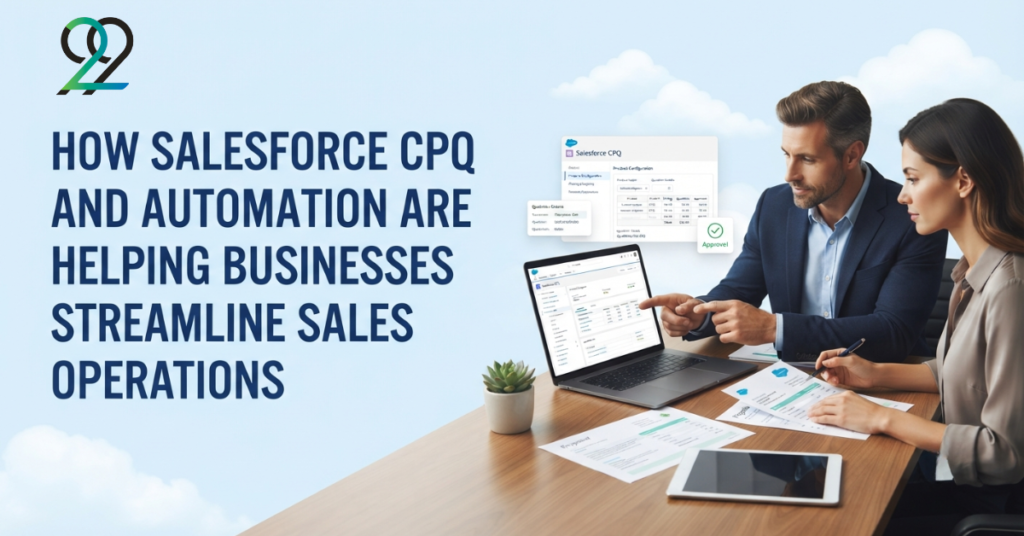
Selling complex products is rarely as simple as selecting an item and generating an invoice. Modern businesses may manage multiple product variations, bundles, pricing structures, discounts, approval requirements, subscriptions, and contract terms. When these processes are handled manually, even a straightforward quote can become surprisingly complicated.
Salesforce CPQ addresses many of these challenges by helping businesses configure products, apply pricing logic, manage discounts, and generate accurate quotes within the Salesforce environment.
When combined with automation, CPQ can become more than a quoting tool. It can support a connected sales process that reduces manual work and helps sales teams move from opportunity to quote more efficiently.
What Is Salesforce CPQ?
Salesforce CPQ, which stands for Configure, Price, Quote, is designed to help businesses manage complex sales processes.
The three core stages are straightforward:
Configure: Select and configure the appropriate products or services.
Price: Apply pricing rules, discounts, and other commercial logic.
Quote: Generate an accurate quote for the customer.
Instead of requiring sales representatives to calculate everything manually, CPQ applies predefined business rules to help standardize the process.
Simplifying Product Configuration
Businesses selling customization products often face a common problem: customers need different combinations of products and services.
For example, a technology company may sell a core platform alongside implementation services, support packages, storage options, and additional features.
With Salesforce CPQ product configuration, these relationships can be structured into product bundles and options.
The system can guide sales representatives toward valid combinations and prevent incompatible selections.
This can reduce errors while making the configuration process easier to manage.
Managing Product Bundles
Product bundles in Salesforce CPQ allow related products or services to be sold together.
A bundle might include:
- A primary product
- Optional accessories
- Required services
- Support packages
- Additional features
Bundle configuration can help sales representatives quickly build appropriate offerings instead of manually selecting every related product.
For businesses with large product catalogs, this can significantly simplify the quoting experience.
Automating Pricing Rules
Pricing is another area where manual processes can create problems.
Different customers may receive different pricing based on quantity, contract terms, geography, product combinations, or other business conditions.
Salesforce CPQ pricing rules allow businesses to define logic that automatically influences pricing based on configured criteria.
This creates greater consistency across quotes. Sales representatives spend less time calculating prices and more time focusing on customer conversations.
Managing Discounts and Approvals
Discounts often require approval, particularly when they exceed predefined thresholds.
Without automation, sales representatives may need to send emails, update spreadsheets, or manually follow up with managers.
With CPQ approval workflows, businesses can create structured approval processes based on specific conditions.
For example, a quote exceeding a certain discount level could automatically be routed to the appropriate approver.
This creates greater visibility while reducing delays in the sales cycle.
Generating Accurate Quotes
Quote accuracy matters. A pricing error or missing product can create additional work for sales teams and potentially damage customer relationships.
Salesforce CPQ quote generation helps bring product configuration, pricing, discounts, and other commercial information into a structured quote.
The result is a more consistent process from configuration to customer-facing documentation.
Combining CPQ with Salesforce Automation
The real advantage becomes clearer when CPQ is combined with broader Salesforce automation.
A sales process might look like this:
Opportunity Created → Products Configured → Pricing Applied → Discount Evaluated → Approval Triggered → Quote Generated → Customer Follow-Up
Automation can reduce the amount of manual intervention required between each stage.
Salesforce Flow and other automation capabilities can support tasks, notifications, approvals, and record updates around the CPQ process.
Improving Sales Productivity
Sales representatives should spend their time selling, not calculating product combinations or searching for approval emails.
By automating repetitive activities, Salesforce CPQ solutions can help sales teams work more efficiently.
Benefits may include:
- Faster quote creation
- Reduced pricing errors
- Consistent product configuration
- Better approval visibility
- Standardized sales processes
- Improved operational efficiency
The exact impact depends on the quality of the implementation and how closely the system reflects the organization’s actual sales process.
Supporting Complex Business Models
CPQ becomes particularly useful for organizations with complicated commercial structures.
Businesses selling subscriptions, services, bundles, configurable products, or recurring offerings can use CPQ to manage more sophisticated quoting requirements.
As the product catalog grows, maintaining these rules centrally can also become easier than relying on spreadsheets or individual sales representatives to remember pricing requirements.
Integrating CPQ with Other Business Systems
Sales operations rarely stop at Salesforce. Quotes may need to connect with ERP platforms, billing applications, contract systems, or other enterprise tools.
Salesforce CPQ integrations can help create a connected flow of information between these systems.
For example, quote information may need to move into an ERP system after approval, while billing information may need to return to Salesforce.
A well-designed integration strategy helps reduce duplicate data entry and improves consistency across business applications.
The Role of 9to9Clouds
9to9Clouds provides Salesforce-focused services covering Salesforce CPQ, OmniStudio, automation, integrations, customization, and digital transformation.
Its approach focuses on understanding the underlying business process before configuring the technology. This matters because CPQ implementations can become difficult to maintain when product rules, pricing logic, and approval processes are added without a clear structure.
A well-planned implementation helps businesses create a CPQ environment that can evolve as products, pricing models, and sales strategies change.
Conclusion
Salesforce CPQ and automation can simplify some of the most complicated parts of the sales process. From product configuration and pricing to discounts, approvals, and quote generation, CPQ provides a structured foundation for managing complex sales operations.
Automation extends that value by reducing repetitive work and connecting individual stages of the sales cycle.
For organizations managing complex products or growing sales operations, the goal should not simply be to automate everything. The better approach is to identify where manual processes create delays or errors and then use Salesforce CPQ and automation to address those specific challenges.
With the right architecture and implementation strategy, CPQ can become an important part of a scalable Salesforce sales automation ecosystem—helping teams work faster, quote more accurately, and manage increasingly complex commercial processes with greater control.